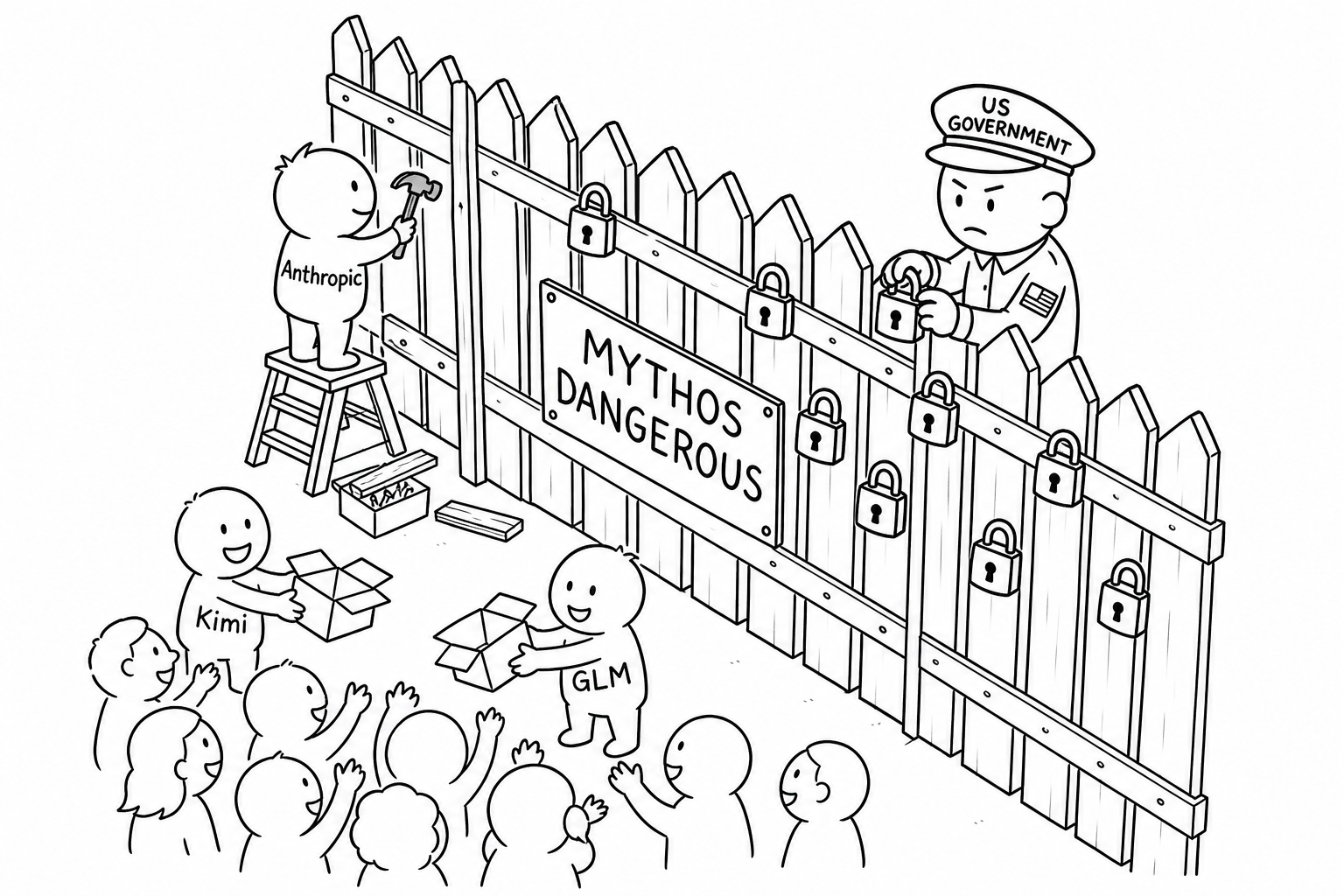
Anthropic released Fable 5 on June 9. Moonshot AI released Kimi K2.7-Code on June 12 at 18:45 Beijing time. The US Commerce Department issued its export control order at 17:21 ET on June 12 — 05:21 Beijing time on June 13. Zhipu announced GLM-5.2 would open at 17:21 Beijing time on June 13123. In the span of one week, the map of frontier AI was redrawn.
Anthropic spent two months telling the world how dangerous Mythos was — it could find software vulnerabilities, it could be used for cyberattacks, it needed restricted access4. The US government took the message seriously. Commerce Secretary Howard Lutnick sent a letter to CEO Dario Amodei at 5:21 PM ET on June 12, invoking national security authorities to bar any foreign national from accessing either model, regardless of location15.
The order’s cruelty lay in its basis: citizenship, not geography. Green card holders, visa workers, even Anthropic’s own foreign-born engineers within the US — all covered56. This treatment previously applied only to nuclear technology and stealth fighters. A language model receiving the same restrictions is a first for the AI industry.
Ask and You Shall Receive
Looking at the timeline, it’s hard not to conclude that Anthropic was tightening the noose around its own neck.
On February 26, Anthropic issued a public statement saying Mythos was too dangerous for public release — limited to roughly 40 vetted organizations7. The statement framed the model around cyber-task capability, vulnerability discovery, and misuse risk — the same qualities Anthropic cited to justify restricted access.
On February 27, Defense Secretary Pete Hegseth labeled Anthropic a “supply chain risk” — a designation previously reserved for foreign adversaries like Huawei, never applied to a US company89. The trigger: Anthropic refused to hand Claude to the military for two purposes — mass surveillance of US citizens and autonomous lethal weapons without human intervention8.
In March, Anthropic sued the Pentagon. In April, an appeals court rejected the request to suspend the supply chain risk designation9. Meanwhile, Axios revealed that the NSA was secretly using Mythos — the same government, one department saying the model was too dangerous to use, another already deploying it for offensive cyber operations10.
On June 9, Anthropic released Fable 5, the “safe version,” with classifiers that force-route queries touching cybersecurity, biology, or chemistry to the older Opus 4.8 model4. The classifiers were so sensitive that asking “what is protein” triggered a block11. What angered researchers most was a hidden clause on page 13 of the system card: silent degradation of queries targeting “frontier LLM development” — AI researcher Nathan Lambert called it “appalling,” Dean Ball labeled it “shockingly hostile”12.
On June 11, Anthropic adjusted under pressure: changed “silent degradation” to “transparent routing to Opus 4.8 with user notification.” The restriction stayed — only the execution changed12. But the adjustment didn’t solve the problem. Normal work was still being blocked. Biologists asking about proteins, analysts processing RNA sequencing data, even resume editing triggered the classifiers411. Users paid for Fable 5 and received Opus 4.8 answers.
On June 12, the Commerce Department export control order arrived1. Anthropic immediately pushed back, stating that the government’s cited bypass demonstration exposed “a small number of previously known, minor vulnerabilities” and that similar safety-bypass issues are “widely available from other models, including OpenAI’s GPT-5.5”13. Anthropic’s point was not that Fable has a unique ability to bypass safeguards, but that these issues are not unique to Fable and appear across frontier models13.
Read one way, the timeline carries a certain irony: Anthropic spent months emphasizing Mythos’s danger, the government concluded it was indeed dangerous, and the resulting controls now bar Anthropic itself from using its own model. Whether Anthropic’s warnings directly caused the ban, or simply aligned with pre-existing government intent, is impossible to prove from the outside. But the sequence is hard to ignore.
The Citizenship Threshold: Unprecedented Restrictions
What makes this order most unsettling isn’t “frontier model export restrictions” — that’s routine in semiconductors. What’s unprecedented is the citizenship basis.
Previous export controls were geographic: your location determined which rules applied. Chip restrictions targeted “shipments to China,” not “sales to Chinese people.” But the Fable 5/Mythos 5 order targets who you are: anyone who isn’t a US citizen is barred, whether they’re in the US, in Germany, in Japan, or in their own office56.
This means a senior Anthropic engineer working in San Francisco on a green card cannot access the model they helped build. An American citizen in Berlin can use it freely; their German colleague sitting next to them cannot.
Anthropic has KYC verification for account holders, so in principle it knows who registered. But account holder identity ≠ the actual user behind every API call. Enterprise customers route API through their own apps; an organization may have employees of many different nationalities. Third-party platforms like OpenRouter and Amazon Bedrock sit between Anthropic and the end user — should they also KYC their users? The compliance chain grows longer, making commercial operations nearly impossible5.
On top of that, Fable 5 raised data retention questions: user queries, classifier trigger logs, degradation records — how this data is handled, how long it’s kept, who can access it — all unresolved compliance risks.
A government official told media that the models must remain restricted until the US national security apparatus is “hardened,” expected to take “several weeks”5. But no one has explained what national security risks a language model poses that requires hardening.
Chinese Models Fill the Gap
Just before and after the Fable 5 shutdown, two Chinese companies released open-source models.
On June 12 at 18:45 Beijing time, Moonshot AI released Kimi K2.7-Code, weights published to Hugging Face under a Modified MIT license214 — a few hours before the US Commerce Department issued its order. The order arrived at 17:21 ET on June 12, which is 05:21 Beijing time on June 13. Later that same Beijing day, Zhipu announced GLM-5.2 would open at 17:21 Beijing time on June 13, model weights under MIT license3.
K2.7-Code is a 1-trillion-parameter mixture-of-experts architecture with 32 billion active parameters and a 256K context window214. It scored 21.8% higher than its predecessor K2.6 on Kimi Code Bench v2, with 30% lower reasoning token usage2.
GLM-5.2 is Zhipu’s most capable open-source model, supporting 1 million token context, with API access available next week3.
On pricing, K2.7-Code charges $0.95 per million input tokens and $4.00 per million output tokens1415. For comparison, Fable 5 is $10/$50, Opus 4.8 is $5/$25, GPT-5.5 is $5/$3015. K2.7’s output price is one-twelfth of Fable 5’s.
Table 1: Frontier Model API Pricing Comparison 15
| Model | Input (/1M tokens) | Output (/1M tokens) | Open Source |
|---|---|---|---|
| Kimi K2.7-Code | $0.95 | $4.00 | Modified MIT |
| Claude Opus 4.8 | $5.00 | $25.00 | No |
| GPT-5.5 | $5.00 | $30.00 | No |
| Claude Fable 5 | $10.00 | $50.00 | No |
Both companies’ announcements carried strikingly similar messaging. Zhipu’s statement pointed directly: “At a moment when some frontier models suddenly became unavailable, we chose to believe in a different path. Frontier intelligence should not belong only to a few people, nor should it be revoked at will by a few rules.”3
“Became unavailable” — referring to the Fable 5 ban earlier that same Beijing day.
Table 2: This Week’s Frontier Model Timeline 123
| Time (Beijing) | Event | Model | Open Source |
|---|---|---|---|
| 6/9 | Anthropic releases | Fable 5 | No |
| 6/12 18:45 | Moonshot releases | K2.7-Code | Yes |
| 6/13 05:21 | US Commerce Dept ban | Mythos 5 | No |
| 6/13 17:21 | Zhipu releases | GLM-5.2 | Yes (MIT) |
Kimi K2.7-Code released on June 12 Beijing time, a few hours before the ban took effect. The ban and GLM-5.2 both fell on June 13 Beijing time, but roughly twelve hours apart — the order at 05:21 and the GLM opening at 17:21.
Two Paths
Put these events together and the industry is splitting into two camps.
The Anthropic path: invest heavily in safety narratives, use classifiers to restrict who can use the model and for what, then have the government take over enforcement. The government’s controls are cruder than Anthropic’s own — a straight citizenship cutoff that blocks even Anthropic’s own employees5.
The Chinese open-source path: two companies releasing open-source models in quick succession, open weights, low pricing, leaving the “who can use this” question to the community. K2.7-Code’s Modified MIT license and GLM-5.2’s MIT license are lightweight accountability mechanisms, not access barriers143.
Anthropic’s dilemma is structural. It needs to repeatedly emphasize Mythos’s danger to build its safety narrative — that’s its capital for fundraising, IPO, and government trust. But once the government accepts that narrative, the scale of controls is no longer in Anthropic’s hands. The more successfully it emphasizes danger, the more aggressively the government responds.
Now it’s caught in the middle: for developers, Fable 5’s over-sensitive classifiers and degraded responses erode trust; for the government, it’s insufficiently cooperative and the model is too dangerous; for competitors, the same cyber-task capabilities Anthropic touted as differentiators became the justification for the ban.
Meanwhile, Kimi K2.7 and GLM-5.2 went open-source in rapid succession, proving through action that there’s more than one path to frontier intelligence. When one company builds walls with classifiers and export controls, others choose to tear them down.
What to Watch
- When will Fable 5 and Mythos 5 access be restored? The government says “several weeks,” but no firm timeline
- Will Anthropic’s IPO be affected? The company previously filed for a secret listing at a $965 billion valuation12
- How will K2.7-Code and GLM-5.2 perform on independent benchmarks? Vendor-reported data needs market validation
- Will the citizenship threshold become the new normal for frontier AI regulation? If a stronger model emerges, will restrictions tighten further?
References
Footnotes
-
Fortune — Anthropic disables Fable and Mythos AI models following U.S. government export ban https://fortune.com/2026/06/13/anthropic-disables-fable-mythos-export-controls-national-security-threat/ ↩ ↩2 ↩3 ↩4
-
MarkTechPost — Moonshot AI Releases Kimi K2.7-Code: a Coding Model Reporting +21.8% on Kimi Code Bench v2 Over K2.6 https://www.marktechpost.com/2026/06/12/moonshot-ai-releases-kimi-k2-7-code-a-coding-model-reporting-21-8-on-kimi-code-bench-v2-over-k2-6/ ↩ ↩2 ↩3 ↩4 ↩5
-
Zhipu WeChat Official Account — 致开发者:GLM-5.2全量开放,前沿智能属于所有人 https://mp.weixin.qq.com/s/LDrbtLM0wiCTJorvd5GY9w ↩ ↩2 ↩3 ↩4 ↩5 ↩6
-
Ars Technica — Anthropic says these topics are too dangerous to let its Fable 5 model talk about https://arstechnica.com/ai/2026/06/anthropic-says-these-topics-are-too-dangerous-to-let-its-fable-5-model-talk-about/ ↩ ↩2 ↩3
-
I-scoop — Fable 5 Blocked Outside the US After Government Export Order https://www.i-scoop.eu/fable-5-blocked-outside-the-us-after-government-export-order/ ↩ ↩2 ↩3 ↩4 ↩5 ↩6
-
TweakTown — Anthropic’s latest AI model ‘Fable’ was so powerful the US government banned the world from it https://www.tweaktown.com/news/112176/anthropics-latest-ai-model-fable-was-so-powerful-the-us-government-banned-the-world-from-it/index.html ↩ ↩2
-
BBC — Claude Mythos: Anthropic releases version of AI tool despite risk concerns https://www.bbc.com/news/articles/ckg701v1dp6o ↩
-
Bloomberg / Yahoo Finance — 美國國防部公開設下最後期限 要求不受限使用Anthropic AI工具 https://hk.finance.yahoo.com/news/%E7%BE%8E%E5%9C%8B%E5%9C%8B%E9%98%B2%E9%83%A8%E5%85%AC%E9%96%8B%E8%A8%AD%E4%B8%8B%E6%9C%80%E5%BE%8C%E6%9C%9F%E9%99%90-%E8%A6%81%E6%B1%82%E4%B8%8D%E5%8F%97%E9%99%90%E4%BD%BF%E7%94%A8anthropic-ai%E5%B7%A5%E5%85%B7-204305075.html ↩ ↩2
-
36Kr — 2亿美元 vs 一条底线:Anthropic为何敢对五角大楼说”不”? https://www.36kr.com/p/3711218678575619 ↩ ↩2
-
Gate News — Axios Exclusive: US NSA Bypasses Pentagon Blacklist to Use Anthropic Mythos https://www.gate.com/zh/news/detail/axios-exclusive-the-us-nsa-bypassed-the-pentagon-blacklist-to-use-anthropic-20444812 ↩
-
Fast Company — Anthropic’s Claude Fable 5 plays it too safe on safety, developers say https://www.fastcompany.com/91558105/anthropic-claude-fable-5-too-touchy-developers-say ↩ ↩2
-
Futurism — Anthropic Was So Concerned About Its New Mythos-Based Model’s Power That It Lobotomized Its Ability to Improve Itself https://futurism.com/artificial-intelligence/anthropic-concerned-models-ability-improve-itself ↩ ↩2 ↩3
-
Anthropic Official Blog — Expanding access to Fable and Mythos https://www.anthropic.com/news/fable-mythos-access ↩ ↩2
-
CryptoBriefing — Kimi AI releases open-source K2.7 Code model with 1 trillion parameters on APIs and Hugging Face https://cryptobriefing.com/kimi-k2-7-code-open-source-release/ ↩ ↩2 ↩3 ↩4
-
The Decoder — Moonshot’s open model Kimi K2.7 Code undercuts GPT-5.5 and Claude by up to 12x on price per token https://the-decoder.com/moonshots-open-model-kimi-k2-7-code-undercuts-gpt-5-5-and-claude-by-up-to-12x-on-price-per-token/ ↩ ↩2 ↩3